
Tackling Poverty
Poverty is a growing problem across the UK, with around 1 in 5 people in Scotland living in relative poverty (After Housing Costs) in the 2017-20. Poverty levels vary by area, and are higher for certain groups such as lone parents, disabled people and those from a minority ethnic background.
Understanding Poverty in Scotland
Around 1 in 5 people (17%) in Scotland were living in relative poverty (After Housing Costs) in 2022-25. Poverty levels vary by area, and are higher for certain groups such as lone parents, disabled people and those from a minority ethnic background.
A widely accepted definition of poverty is:
"When a person's resources (mainly their material resources) are not sufficient to meet their minimum needs (including social participation)."
- Joseph Rowntree Foundation – 2014
Poverty definitions
To truly understand the pressures faced by individuals and families, we look at a range of poverty definitions and metrics. Each one helps build a fuller and more meaningful picture of inequality.
Common poverty terms and their definitions are given below:
· Relative Poverty – this means families whose income falls below that of the average household, showing how many people are struggling compared with typical living standards.
· Absolute Poverty – families on low incomes whose living conditions are not improving over time, even as wider society moves forward.
· Low Income and Material Deprivation – families who not only have a low income but are unable to afford essential items and activities that many take for granted.
· Persistent Poverty – families who remain on a low income for long periods (three out of the last four years), highlighting long‑term and more entrenched disadvantage.
· In-Work Poverty – families where at least one person is in paid employment, yet the household still lives in relative poverty—demonstrating that work alone is not always enough to lift people out of hardship.
Families at a Higher Risk of Poverty
The Scottish Government remains focused on families who are at a higher risk of experiencing poverty. These include:
- Lone parents
- Parents with disabilities
- Families with a disabled child
- Young parents aged 25 years and under
- Minority ethnic families
- Families with 3 or more children
- Families where the youngest child is under 1 year
We know that structural factors outwith the control of families can make it more difficult to enter and progress in the workplace. There are many factors at play including discrimination, which leads to the far higher poverty rates for children in these families.
Key Barriers Families Face
Individuals' ability to enter and progress in work are influenced by their personal and local circumstances. It is important to understand what potential barriers to employment individuals may face in order to develop tailored solutions.
These could include:
- Availability and affordability of childcare;
- Availability and affordability of transport to and from work;
- The strength of the local labour market and availability of suitable jobs;
- Requirements to care for a family member or friend;
- Managing a health condition or disability;
- Lack of relevant skills, qualifications or experience.
A summary of evidence on priority families can be found on the Scottish Government website: Tackling child poverty priority families overview
Poverty Statistics
The Scottish Government and others provide a wealth of statistical evidence and information on poverty in Scotland and across the UK. The latest statistics are published annually (around March) and can be accessed through the Scottish Government website.
Actions to Eradicate Child Poverty
The Child Poverty (Scotland) Act 2017 sets statutory targets which help focus efforts to tackle and ultimately eradicate child poverty. The targets state that in 2030-31, of children living in Scottish households:
- less than 10% should be living in relative poverty
- less than 5% should be living in absolute poverty
- less than 5% should be living with combined low income and material deprivation
- less than 5% should be living in persistent poverty
The Act requires Scottish Ministers to publish child poverty delivery plans, setting out the action they will take, and annual reports to measure progress.
Local Authorities and Health Boards must also jointly publish annual reports on what they are doing to reduce child poverty in the local area.
The Act also established the statutory Poverty and Inequality Commission on 1 July 2019. This independent public body provides advice to Scottish Ministers, scrutinises progress, and promotes action to reduce poverty and inequality.
The most recent Child Poverty Update, published 26 March 2026, shows progress against the targets in the Child Poverty (Scotland) Act 2017.
Our Commitment
There is no ‘single’ solution to eradicate poverty. It is important that we work together across government - and across Scotland – to help individuals and families move out of poverty and deliver the change that is needed. This requires a broad range of actions so that fewer children experience poverty.
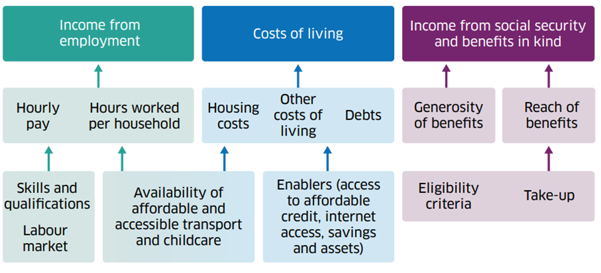
The Scottish Governments Bringing Hope, Building Futures: Tackling child poverty delivery plan 2026-2031, published on 12 March 2026, sets out the key drivers of poverty reduction and actions we can take together to make a difference. The key drivers are summarised in the diagram below:
Child Poverty Targets – Our Approach
Building Hope, Building Futures: Tackling Child Poverty Plan 2026-31, was published on 12 March 2026. This plan outlines the 15 interconnected areas where focused action is needed ahead of 2030, and what we intend to do in 2026-27 to accelerate progress at the pace and scale needed. At its heart is a commitment to ensuring that public services truly wrap around families.
To support the delivery of our wider commitments, we published the No One Left Behind Employability Strategic Plan 2024–2027 on 13 September 2024, setting out the actions that the Scottish Government, Local Government and Delivery Partners will take to enhance the employability landscape. We report on our progress annually, with the first annual report published on 16 December 2025.
The Fair Work Employer Resource Hub provides information for employers on Fair Work principles; how Fair Work benefits both employers and employees; how to combat in-work poverty; how to build diverse and inclusive workplaces; supporting wellbeing at work; and inclusive recruitment.
Progress Against Our Commitments
You can find further research and analysis relating to child poverty as well as Tackling Child Poverty Delivery Plan Progress Reports on the gov.scot website.
Through our No One Left Behind approach, person-centred employability services are available in every Local Authority area for people of all ages who experience structural barriers to participating in the labour market. These services support people towards and into sustainable fair work. We publish quarterly statistical publications providing further detail on the number of people across Scotland accessing our services and outcomes achieved.